
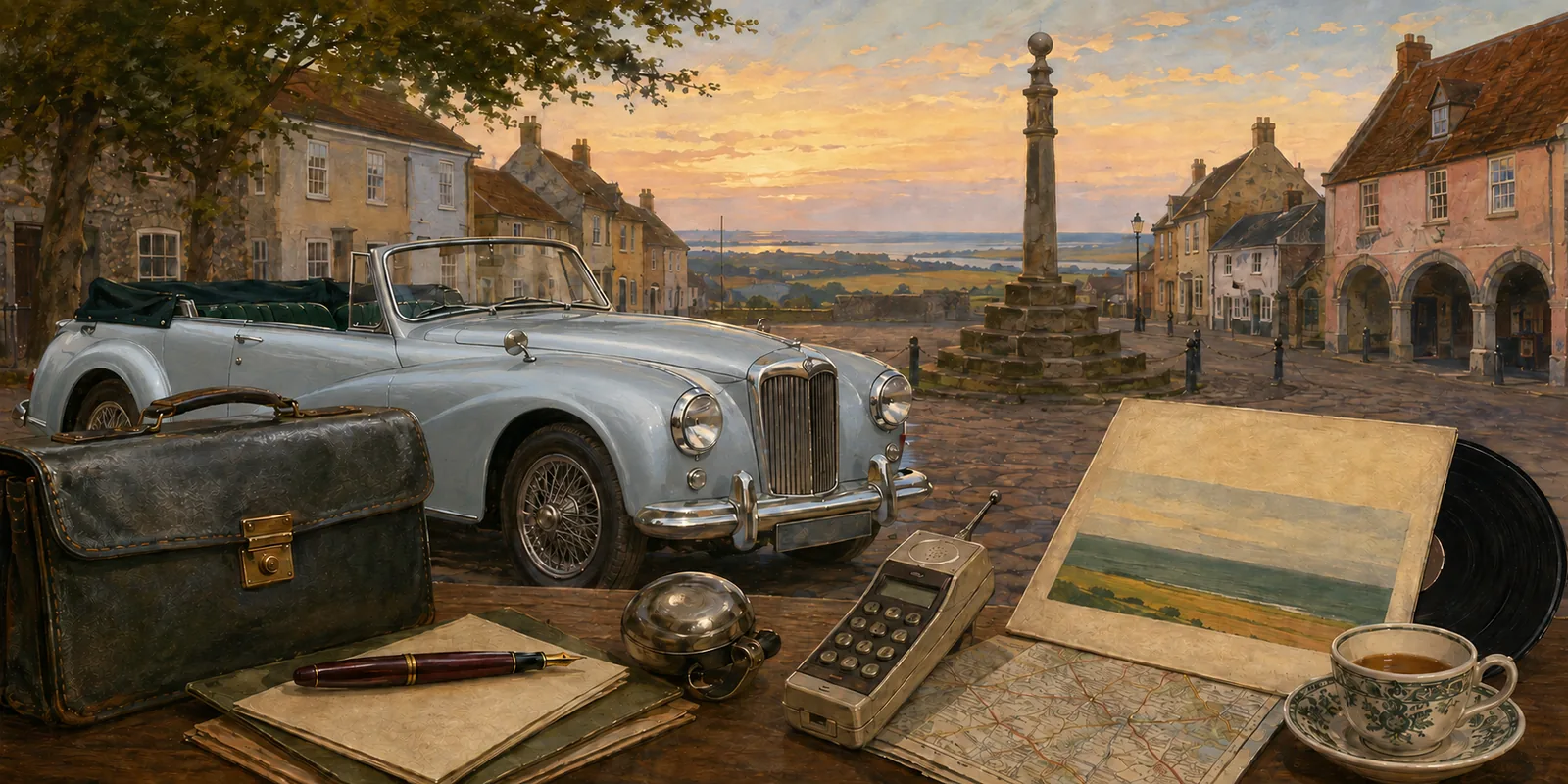
The car’s place in Kingdom is immediately legible: it is an elegant open-top British grand tourer, distinctive without being ostentatious. The programme photograph used by this guide shows a pale metallic silver-blue body, dark green trim and the registration LWH 128C. The colour shifts with light and television grading, so the exact factory paint name is not stated here.
The Alvis te21 in context
The TE21 belongs to Alvis’s post-war Three Litre line of British sporting saloons and drophead coupés. The Alvis Owners’ Club Car History records its launch in 1963 and production through 1966. It was offered as a saloon or drop-head version; the model carried forward the marque’s preference for individually finished, coachbuilt motor cars at a time when mass production was reshaping the British car industry.
The TE21 was the third generation of the Three Litre series, following the TD21. Its bodywork continued the collaboration with Mulliner Park Ward, while the next development, the TF21, arrived in 1966. Those details help explain why Peter’s car looks formal and substantial rather than like a sports car built only for speed. Its long bonnet, upright grille and open cabin give it a measured presence that fits a country solicitor whose work takes him from an office to clients around Norfolk.
The TE21 is part of the last phase of Alvis’s traditional Three Litre touring cars. Its design combined an established mechanical base with bodywork supplied by a specialist coachbuilder, a form of production that gave the car a distinctive finish and a different character from a mass-market saloon. The model was followed by the TF21 in 1966, but its restrained styling already looks like a car intended for long journeys rather than a brief display. That makes its casting as Peter’s everyday transport especially effective: it can look refined in Market Place and still belong on an open Norfolk road.
For model history, see the Alvis Owners’ Club Car History entry for the TE21 ↗. That record concerns the production model generally; the programme car’s visible details are described separately below.
Why it suits Peter Kingdom
The Alvis connects Peter with professional tradition without making him seem remote. Its classic styling gives him a recognisable silhouette, yet the open roof keeps the character visually exposed to the weather and landscape. This is useful screen storytelling: a familiar object can tell the viewer who has arrived before the dialogue begins, while its journeys link the enclosed office with the wider places that form Market Shipborough.
There is also a contrast with Lyle’s bicycle and younger working life. The difference does not make either character a simple type; it gives their professional partnership a visual counterpoint. Peter’s car suggests established habits, while his patience with clients repeatedly proves that he is willing to change his mind when the facts or the person in front of him ask him to.
What is visible in the programme material
- Model: Alvis TE21 drophead coupé.
- Commonly reported year: 1965.
- Registration in the supplied photograph: LWH 128C.
- Visible finish: pale metallic silver-blue, with dark green trim.
Light, reflections and colour grading change the way the paint appears from one image to another. The car’s model history is well documented; a more specific paint-code claim needs a production or vehicle record tied to this individual car.
The car and the Norfolk geography
Peter’s journeys help the series present Swaffham, Wells-next-the-Sea and Holkham as parts of one community. In real life the locations are separate, with different roads, public access and visitor arrangements. The car helps the edit make the fictional journey feel natural; it is not a guide to a real-world route. Use the filming-location guide for the map and the visitor pages for trip planning.
On a rewatch
Notice when the Alvis is used as a transition: an arrival at the practice, a departure from town or a journey towards the coast gives the scene a shift in scale. Its visual presence also sits beside the office telephone, files and Peter’s suits as part of his recognisable world. The continuity notebook follows the objects and family threads that gather meaning across the series.